| Humans tend to be territorial beings. Battles continue to rage over control of land, borders expanding or contracting depending on the spoils of war. Britain's history continually reflects such disputes. The borders between England and its two neighboring nations, Wales and Scotland, were the sites of frequent warfare. The English monarchs have alternately waged war against the local populace or built walls to keep the Welsh and Scots at bay, barricaded from entering England. Earlier invaders also used barricades along the borderlands - Offa's Dyke and Hadrian's Wall are two examples. Today, the struggle for independence remains at the forefront of British politics, and patriots from Wales and Scotland strive to separate themselves from England's dominance. And in the Middle Ages, the separation between these lands was established by the creation of Marcher lordships.
The Welsh borderland is still known as "the Marches". After the Norman invasion in 1066, William the Conqueror granted extensive parcels of land along the borders to many of his most prized subjects. These men became Marcher Lords, with the right to build castles and rule their lands as if they themselves were kings. The Marcher Lords still owed allegiance to the English monarch, but had the freedom to administer their feudal estates as they saw fit, much to the displeasure of their Welsh vassals.
Throughout the Welsh Marches, numerous castles were constructed, some great (like Ludlow or Goodrich), some small (Clun, Longtown, Hopton, Bishops Castle), but all symbolizing the Norman domination of Britain. Many of these Marcher castles have survived, some still occupied, some in outstanding repair, and others ruined but worthy of exploration.
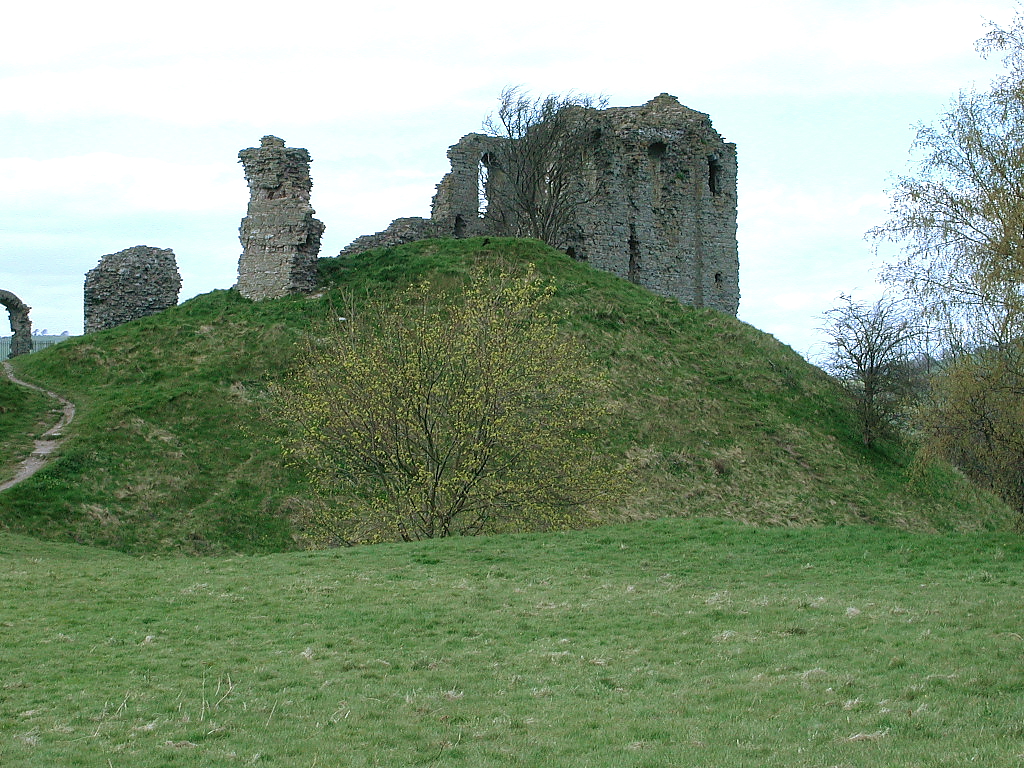
One of these lesser Marcher castles sits in the small village of Clun, located in Shropshire about 10 miles east of the Welsh border. It is about 15 miles south of the pretty Welsh border town of Montgomery, which has its own fine castle ruins. Today the village encroaches upon the castle grounds, and the castle itself is camouflaged behind more recent structures. However, the site itself, with its interesting rectangular keep and two baileys, is easy to spot and well worth the brief trek to reach the keep.
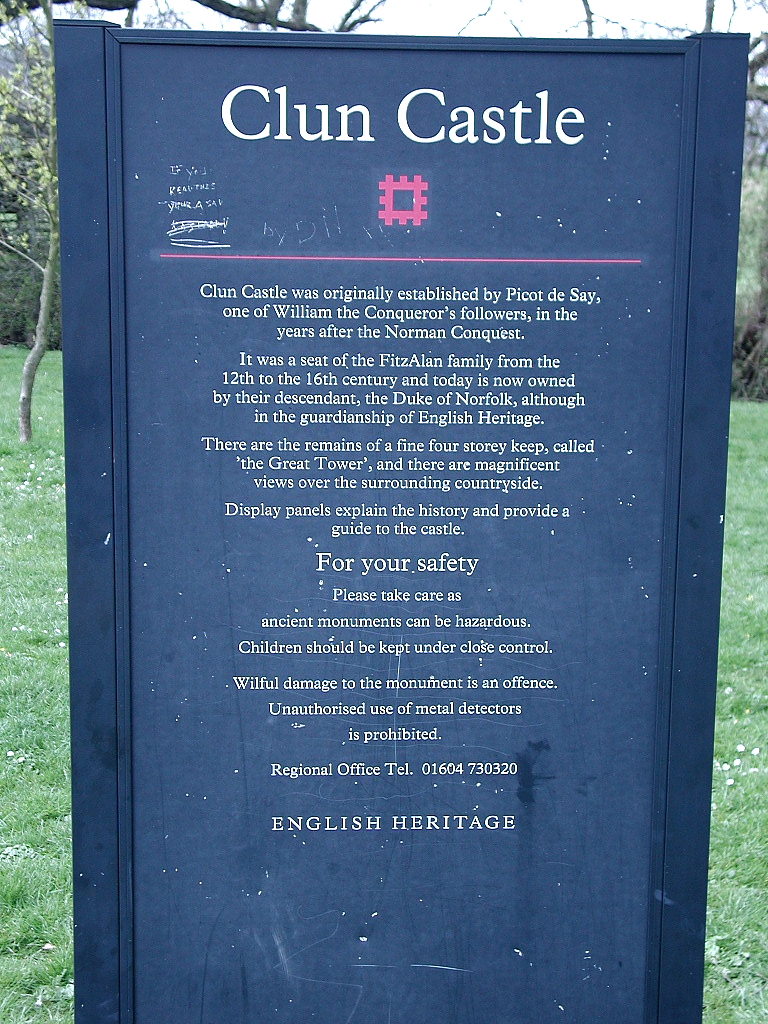
Clun Castle started as a motte and bailey castle, built by the Norman, Robert de Say, around 1140-50, as part of the Marcher lordship known as the Honour of Clun. Overlooking the River Clun and close to the confluence of the Clun and River Usk, the site was chosen for its defensive advantage and the presence of a natural rocky mound which could easily serve as the motte. The castle was originally built with timber defenses, but, probably within 20 years, stone replaced the vulnerable wood and Clun Castle became a typical Norman fortress.
In 1196, Clun Castle was besieged and burned by the Welsh, under the leadership of the great Lord Rhys in 1196. However, it became the property of the prestigious Fitzalan family, who modified the structure into its present form (sans ruins!) and is responsible for the establishment of the associated village. The Fitzalans, lords of Clun and Oswestry, are better known as the Earls of Arundel, builders of mighty Arundel Castle in Southern England. Arundel is now the home of the Dukes of Norfolk, but many of the Fitzalans are interred in the adjacent chapel. While Clun Castle pales in comparison to the Fitzalan's fortress at Arundel, it is a marvelous example of a Marcher castle, intended to keep the unruly Welsh under Norman control.
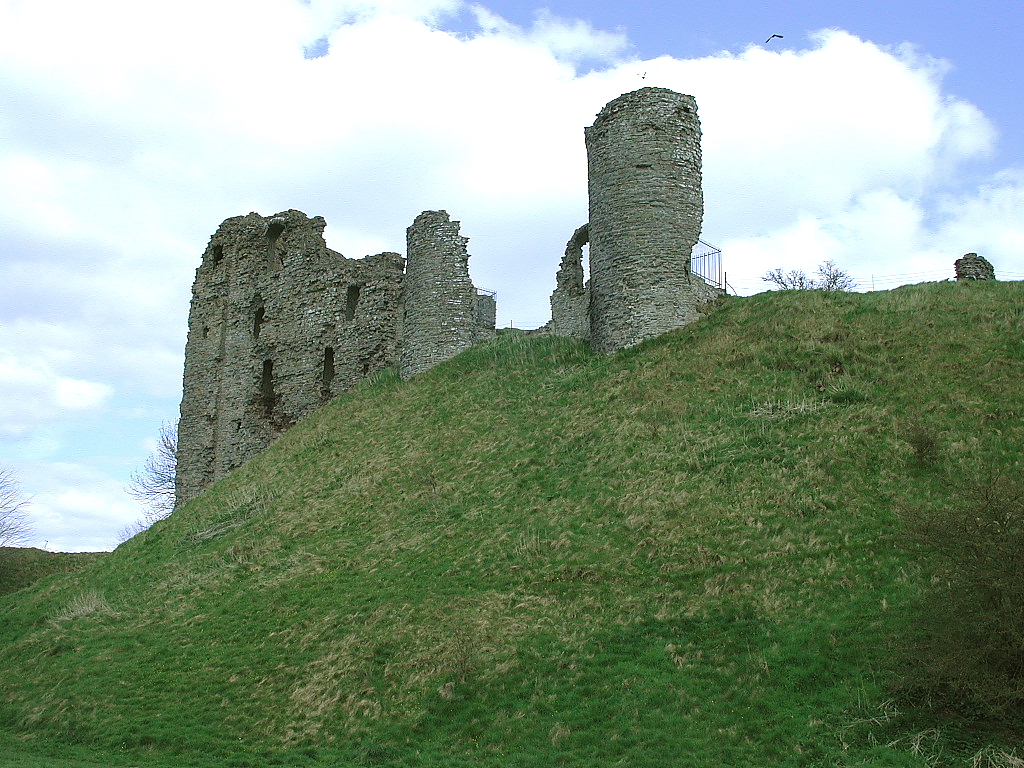
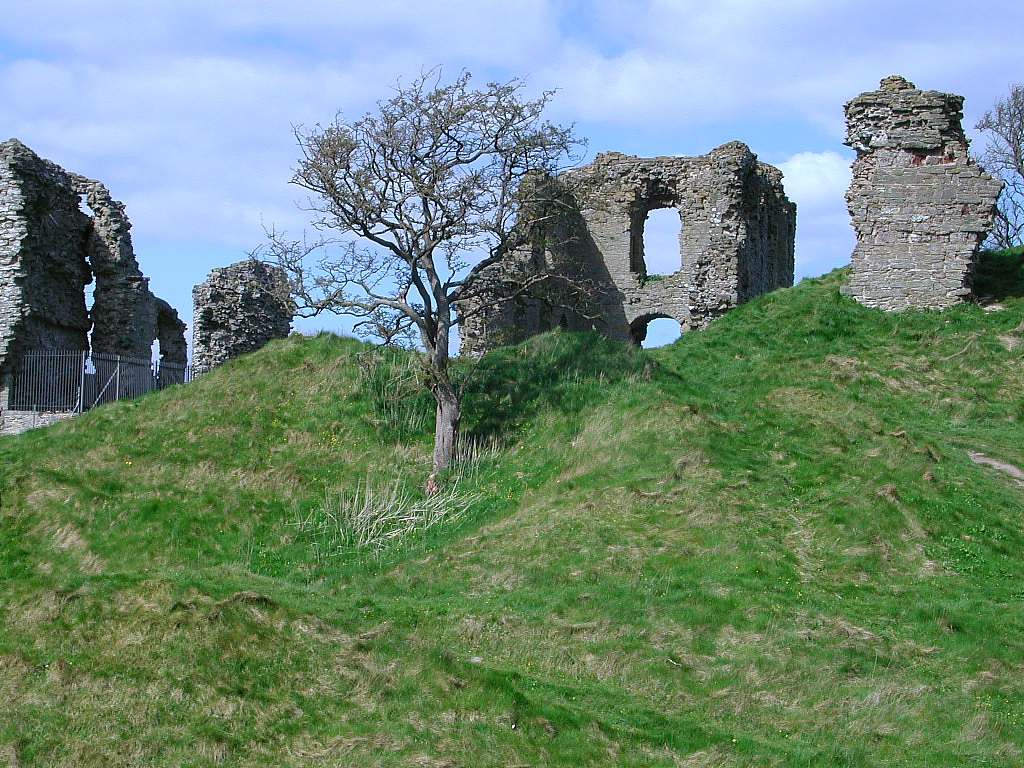
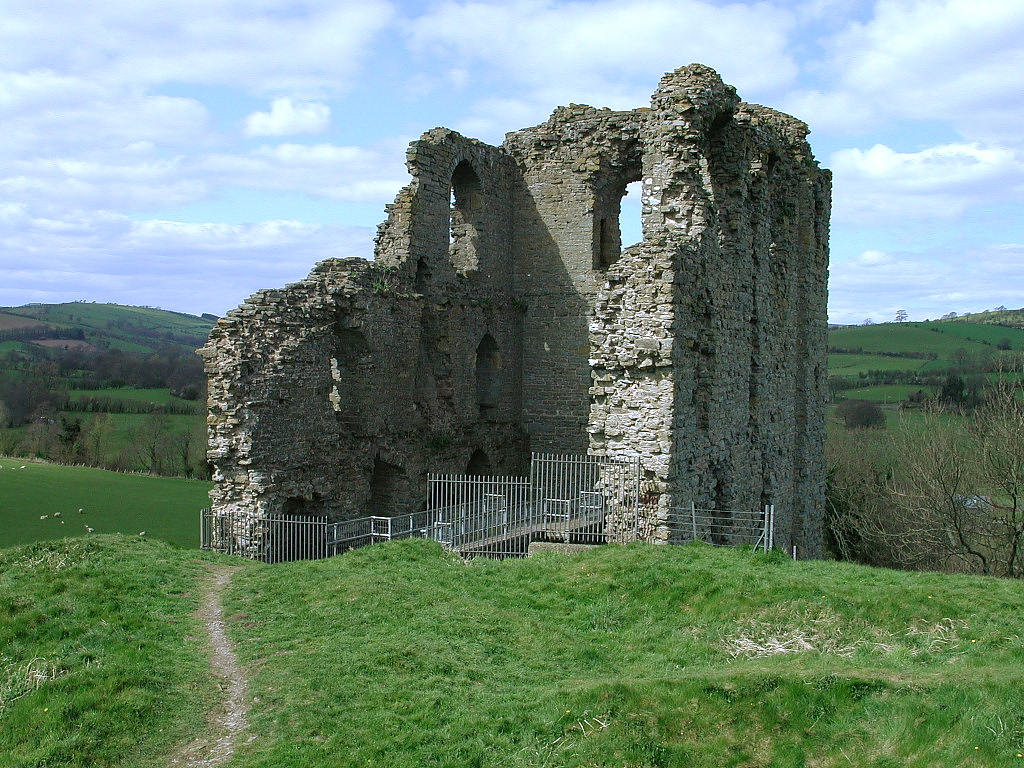
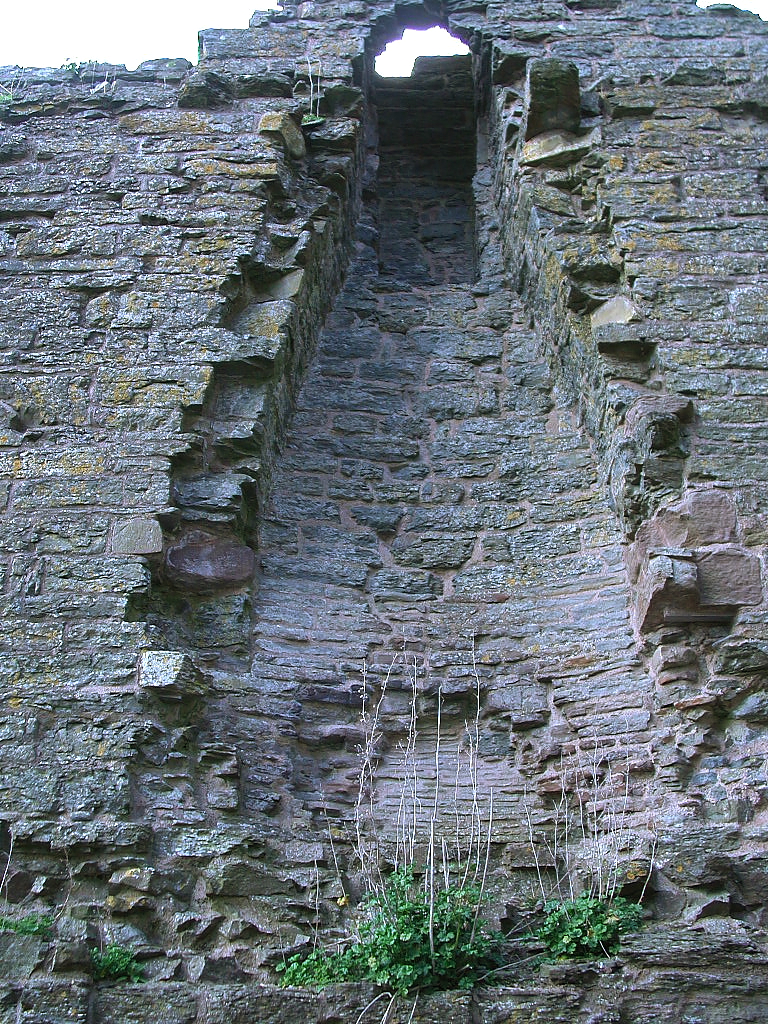
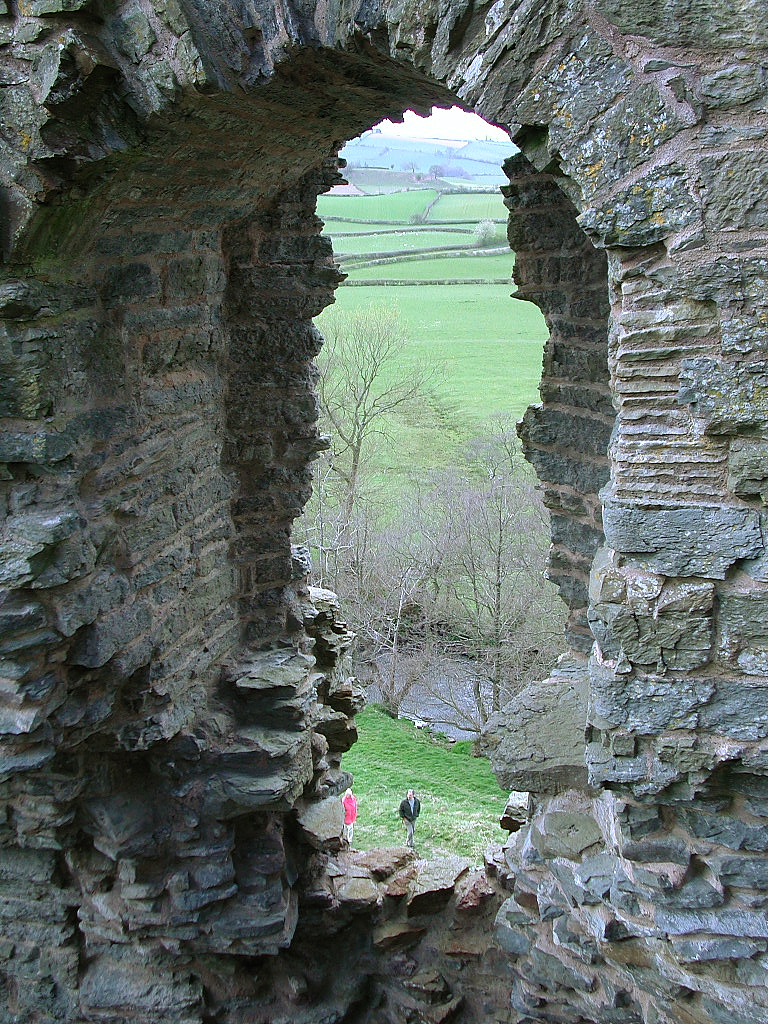
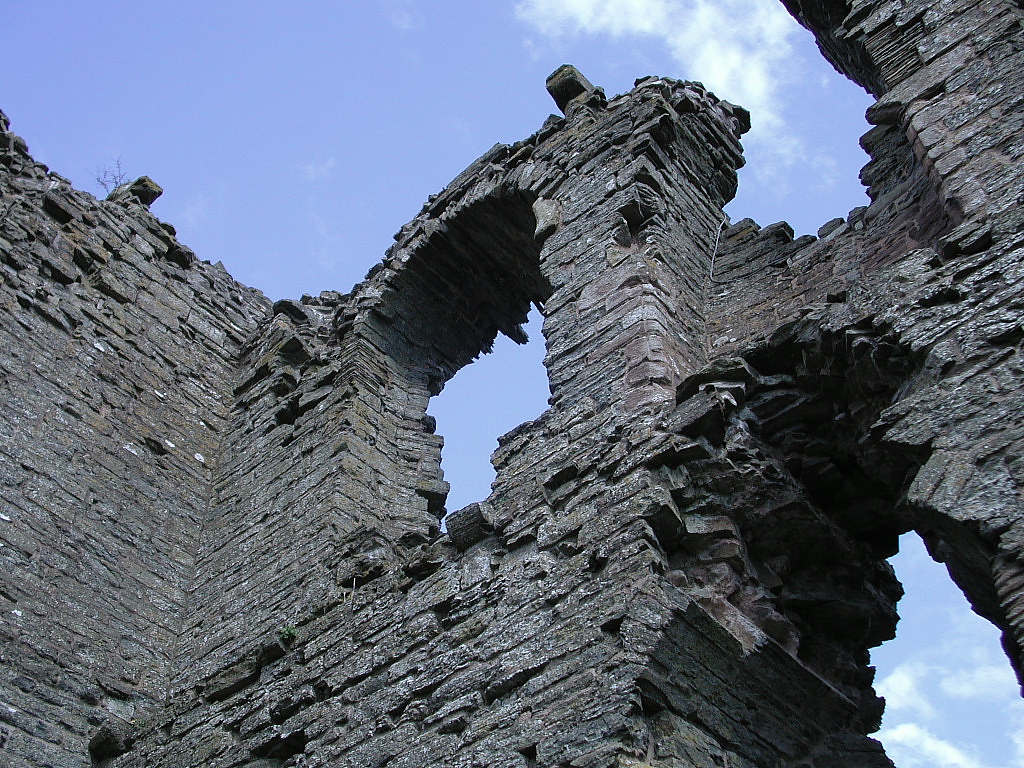
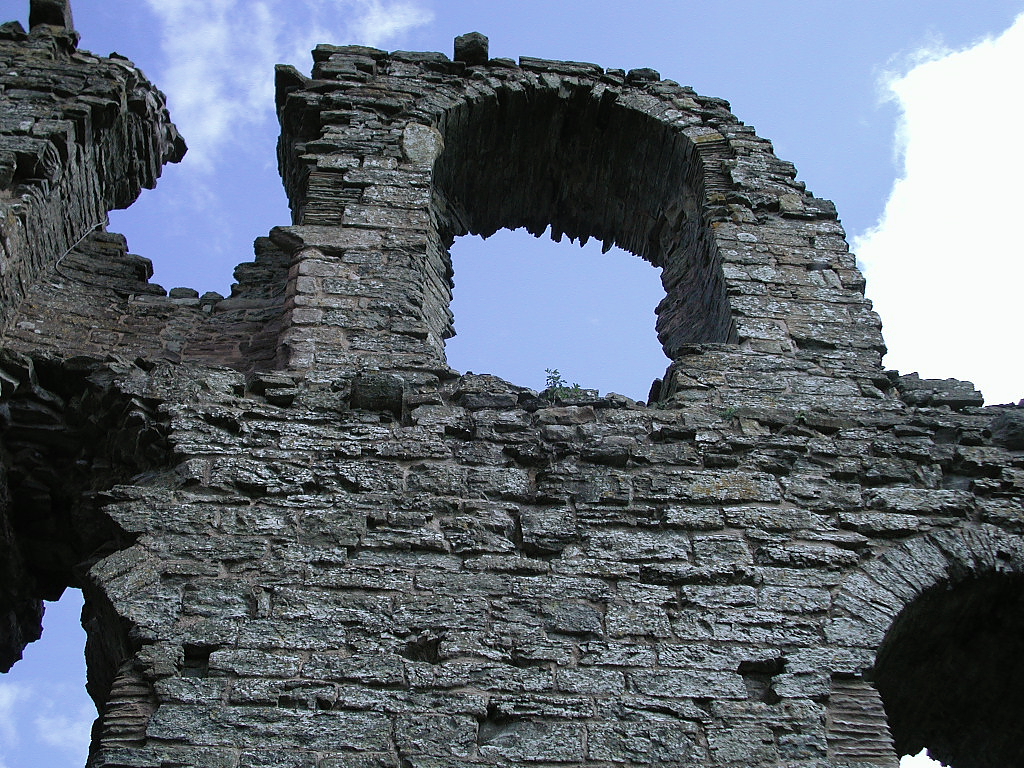
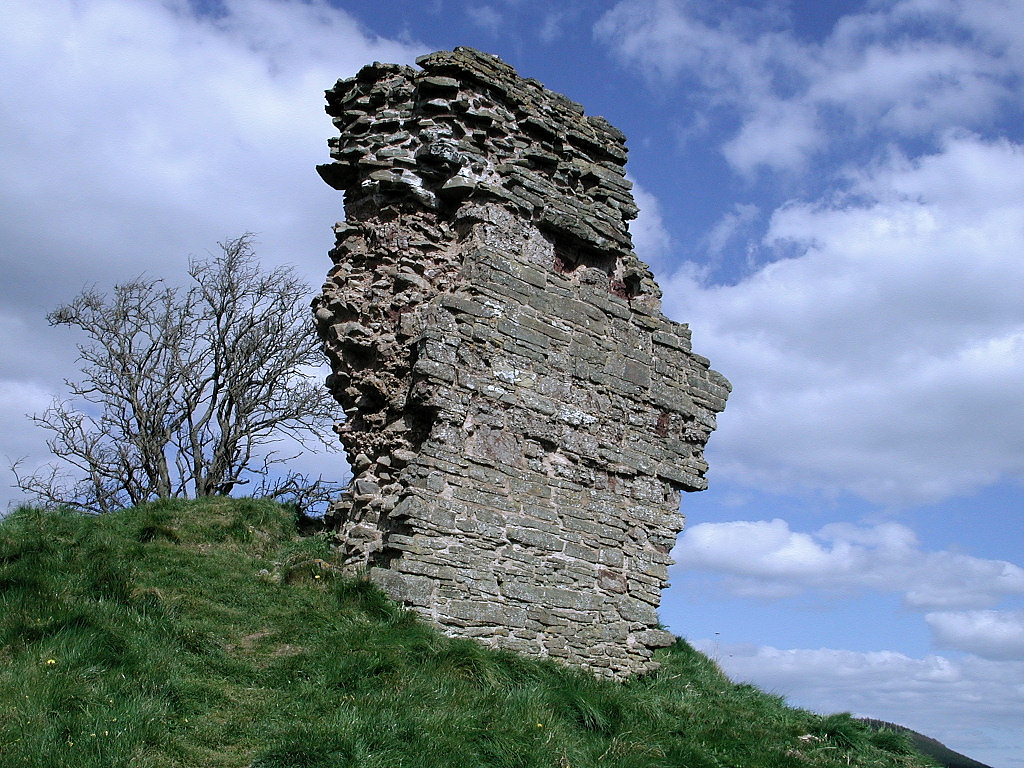
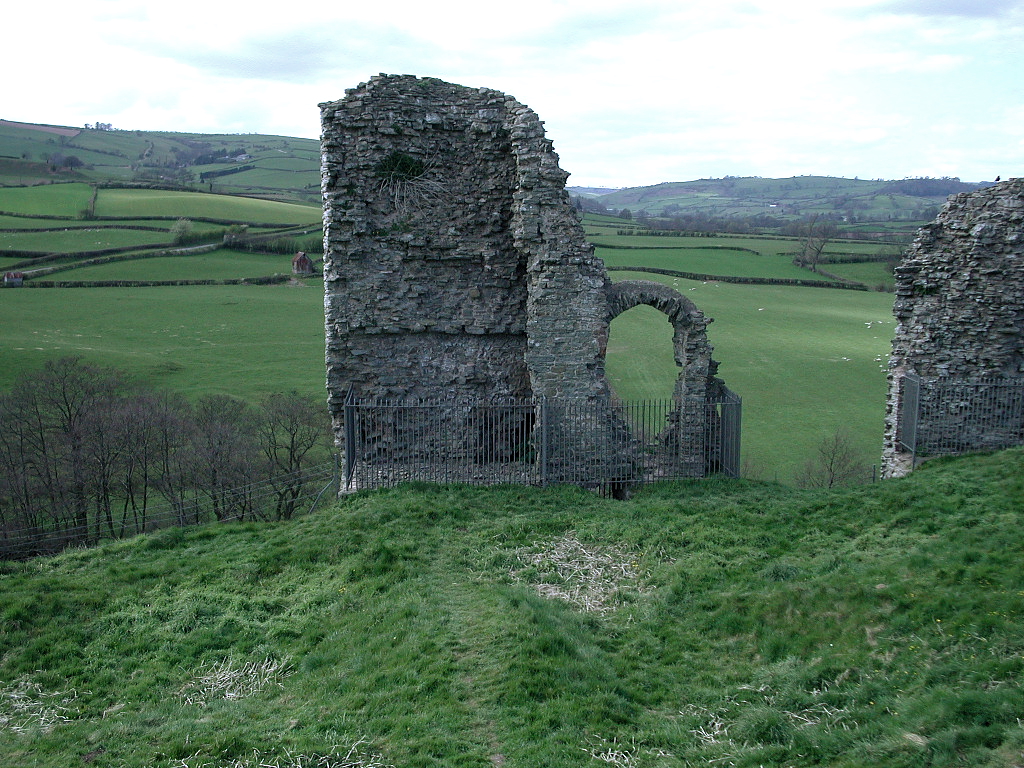
While the settlement at Clun never developed as planned, the castle was a formidable structure and today's visitor can certainly appreciate its original plan. Fronted by ditches and two heavily defended baileys (the massive earthworks best viewed from atop the motte), the motte and its keep offer an unusual spectacle. The greatly ruined keep is in itself a quite typical rectangular tower, but its placement on the steep-sided mound is distinctive. In essence, the 80-foot tall keep was embedded in one side of the motte, perhaps to prevent collapse; one wall rests in the ditch, its opposite sits atop the mound, and the other two climb the rocky slopes. The result is a four-storied keep, having two floors below the summit of the motte. The two others rise above the motte and are amply lit with arched Norman windows. The interior of the keep rests at a rather precariously-angled position, but must have been artificially levelled when originally constructed.
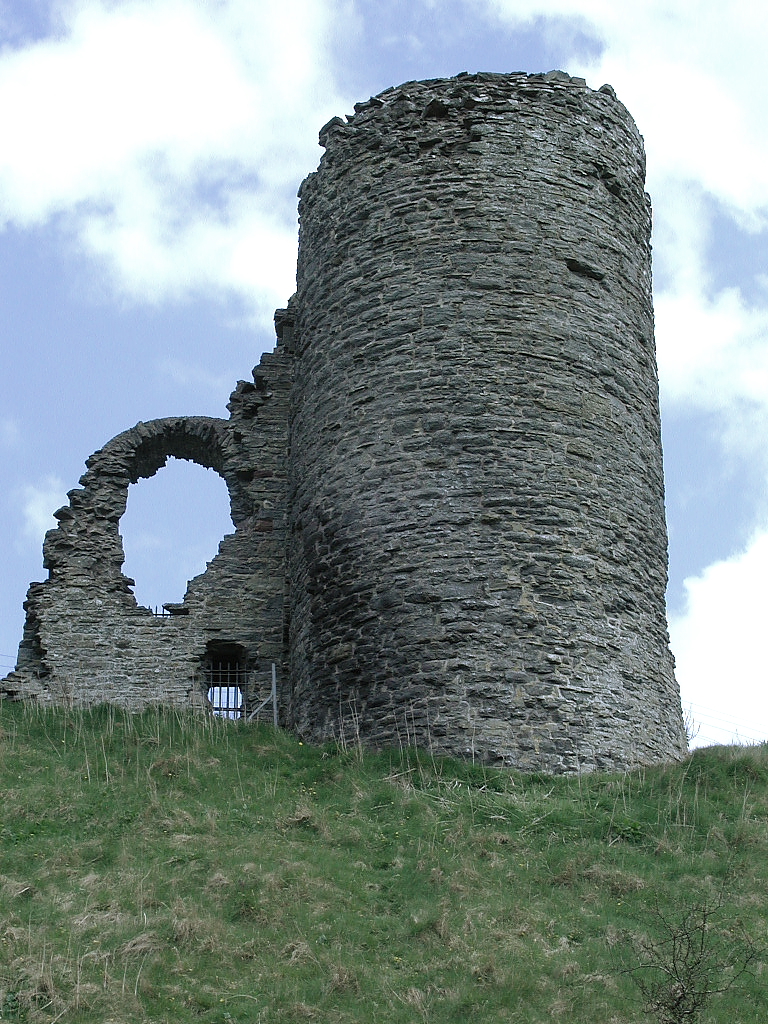
The only other masonry remains at Clun Castle are the remnants of the curtain wall which once enclosed the motte and keep. Built in the late 12th or early 13th century, the stone curtain would have replaced earlier timber palisades. Two round towers have survived from this wall and probably formed part of a fine gateway. Modern access has been limited to the keep because of the instability of its masonry, but the entire structure is visible from motte-level.
Clun Castle saw further military action during the barons' revolt against King John, in the second decade of the 13th century, but was not damaged to any great extent. The Fitzalans kept control of the castle and endeavored to make the village a productive place for the Welsh and English cultures to intermingle. Unfortunately, their effort was short-lived, and by the 1270's the Fitzalans abandoned the Marcher castle to focus their attention and wealth on the more impressive Arundel Castle. Consequently, Clun Castle fell into ruin. Although Owain Glyndwr attacked the castle in the early 1400's, it was no longer the formidable foe it would have been two centuries earlier. After Glyndwr's assault, the castle vanishes from historical records.
Clun Castle is freely accessible to the public, the grounds of the baileys available for picnicking. This fine Marcher castle is only one of several in the area. Others will be discussed in future articles.
An avid traveler, Lise Hull is a freelance historian and writer, with a Masters Degree in Historic Preservation. She previously obtained a BA in anthropology, minoring in archaeology, and spent almost three years studying archaeology at Indiana University prior to switching into the preservation program. Lise has lived in Pembrokeshire and Ceredigion Wales for several years, traveled over 50,000 miles throughout Britain, and has studied castles and medieval Britain for sixteen years. She often returns to Great Britain for research, and has just completed her master's dissertation in Heritage Studies in the Department of History and Welsh History at the University of Wales, Aberystwyth.
|