Home | Main Menu | Castle Index | Historical Essays | Recommended Castles | What's New | Links
The 1287 Siege of Dryslwyn Castle
Photographs copyright © 2002 by Jeffrey L. Thomas
Home | Main Menu | Castle Index | Historical Essays | Recommended Castles | What's New | Links
Photographs copyright © 2002 by Jeffrey L. Thomas
|
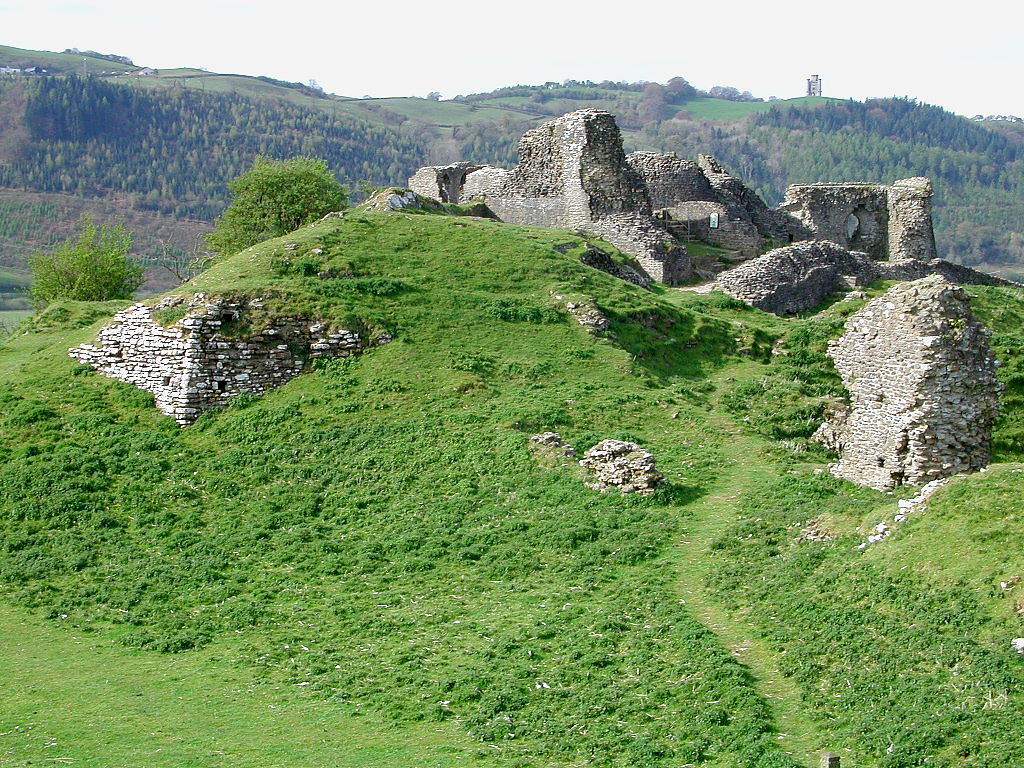
From the official Cadw Guidebook for Dryslwyn Castle In the wake of Rhys ap Maredudd’s revolt of 1287, there was a swift, well coordinated, and effective English reaction. With Edward I out of the country, it was left to his lieutenant in England, Earl Edmund of Cornwall, to take the lead. A great army was to be assembled at Carmarthen, and on 16 July writs were dispatched to the lords of the March to raise their forces. On 9 August, Earl Edmund set out from Carmarthen for Rhys’s castle at Dryslwyn, at the head of an army of some 4,000 men. Some of these had been raised in England, others had been assembled locally under Robert de Tibetot. On 15 August, the earl’s forces were joined by an army of 6,700 ranks and officers, gathered under Reginald Grey (d.1308) who had set out from Chester and Roger l’Estrange who had marched from Montgomery. With the combined force of more than 11,000 assembled on the flat valley floor in front of Dryslwyn, on or just after the 15 August, the siege of Dryswlyn Castle began. Many of the men coming from Chester were drawn from the building works on King Edward’s north Wales castles. These craftsmen and others constructed a trebuchet, a siege machine capable of hurling huge stones at the castle walls. This machine, constructed with timber, hides, rope, and lead, cost £14. A total of 20 quarrymen and 24 carters were employed to shape and move the large stone balls which were hurled by the trebuchet at the castle. In addition, the besiegers were attempting to undermine the castle walls. Tradition records that they brought down a large section near the projecting chapel block. The mining was marred by the collapse of a wall, crushing to death a group of nobles who were inspecting the work, including the earl of Stafford, Sir William de Monte Caniso, and Sir John de Bonvillars. The castle was captured by 5 September, and although Rhys ap Maredudd escaped, his wife and son were captured. The siege undoubtedly caused extensive damage to the castle, and repairs were carried out shortly afterwards. The archaeological excavation of the site has produced important evidence from the time of this siege. Two substantial stone balls, over 16 inches, and almost certainly thrown by the trebuchet, were recovered. Also recovered were many smaller stones which were thrown at the castle, as well as links of chain mail, arrowheads, slingshots and a spearhead. Over one hundred arrowheads were recovered, many with long sharp points deliberately made to penetrate amour and chain mail.
|
 |
 Learn more about castle siegecraft and defence Return to the Dryslwyn Castle page Learn more about castle siegecraft and defence Return to the Dryslwyn Castle page |

Home | Main Menu | Castle Index | Historical Essays | Recommended Castles | What's New | Links
Copyright © 2009 by Jeffrey L. Thomas