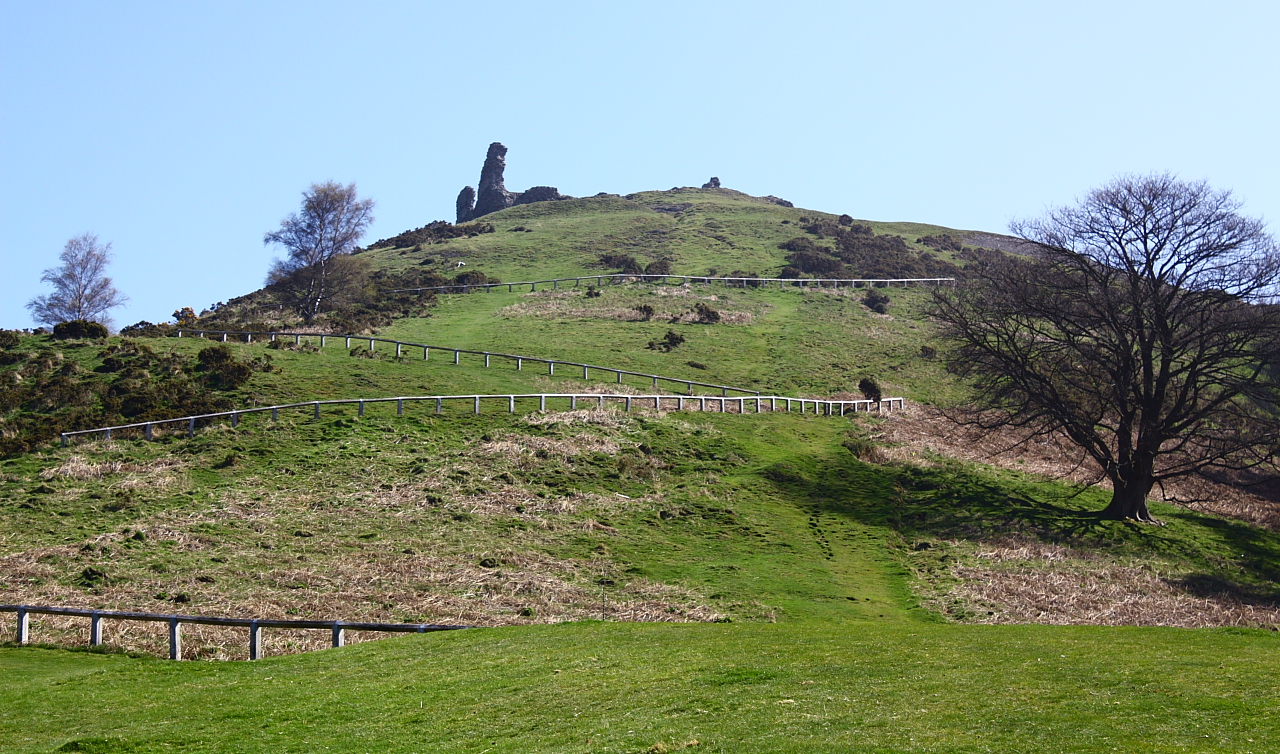
| Towering high above the Dee Valley and the bustling town of Llangollen, home of the International Eisteddfod, Castell Dinas Bran occupies one of Britain's most spectacular sites. A rugged, foreboding pinnacle, the hillock was the ideal spot to erect a castle. It seemed completely impenetrable, commanded views for miles around, and offered quick recognition of an approaching visitor, whether friend or foe. Yet, the native Welsh princes of Powys occupied the hilltop for only a few decades.
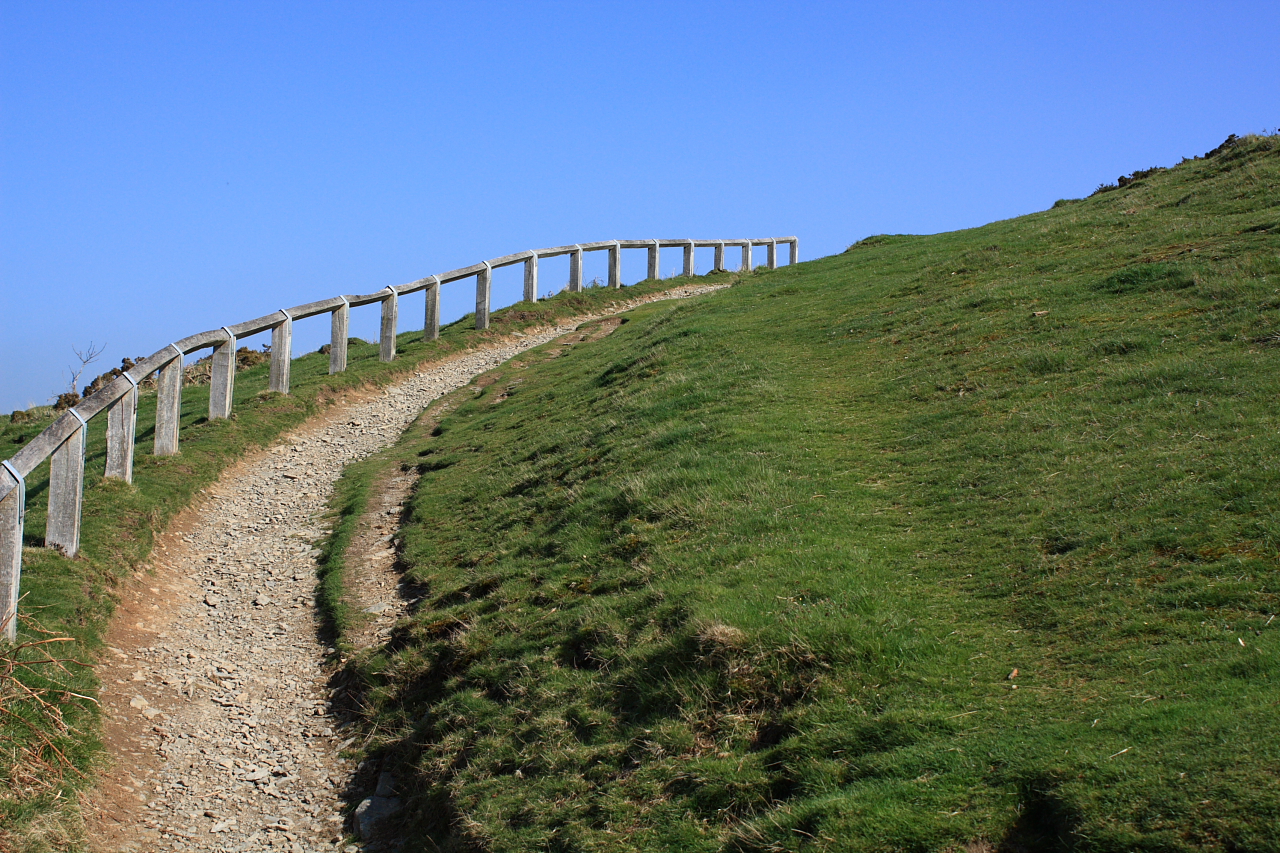
Today, that same site is open to exploration by the public. Forced to climb to the summit, modern visitors experience the struggle and the exhilaration that the castle's medieval inhabitants - and their Edwardian attackers - must have felt. Without a doubt, the walk is a breathtaking challenge. However, that climb heightens the allure of Dinas Bran. And, it demonstrates the stark reality of medieval castle life.
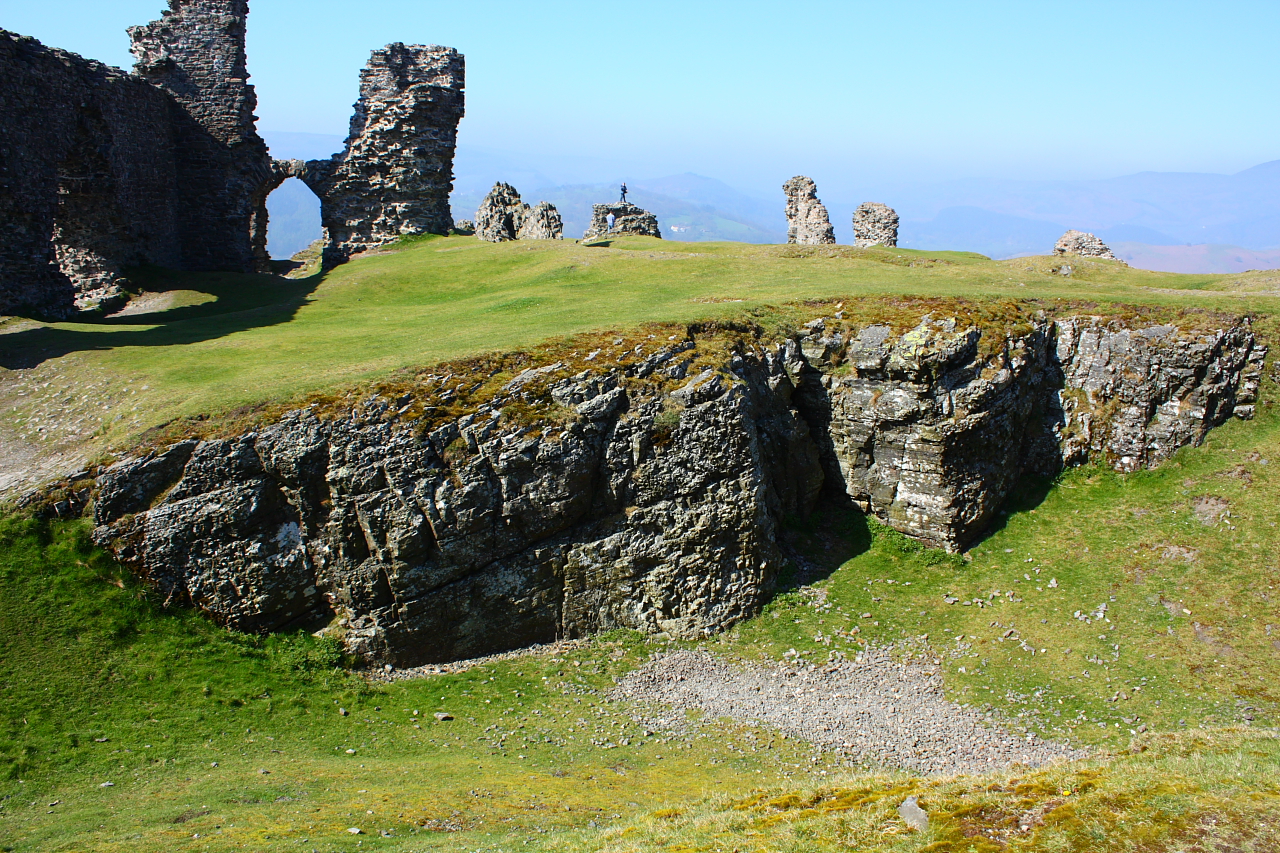
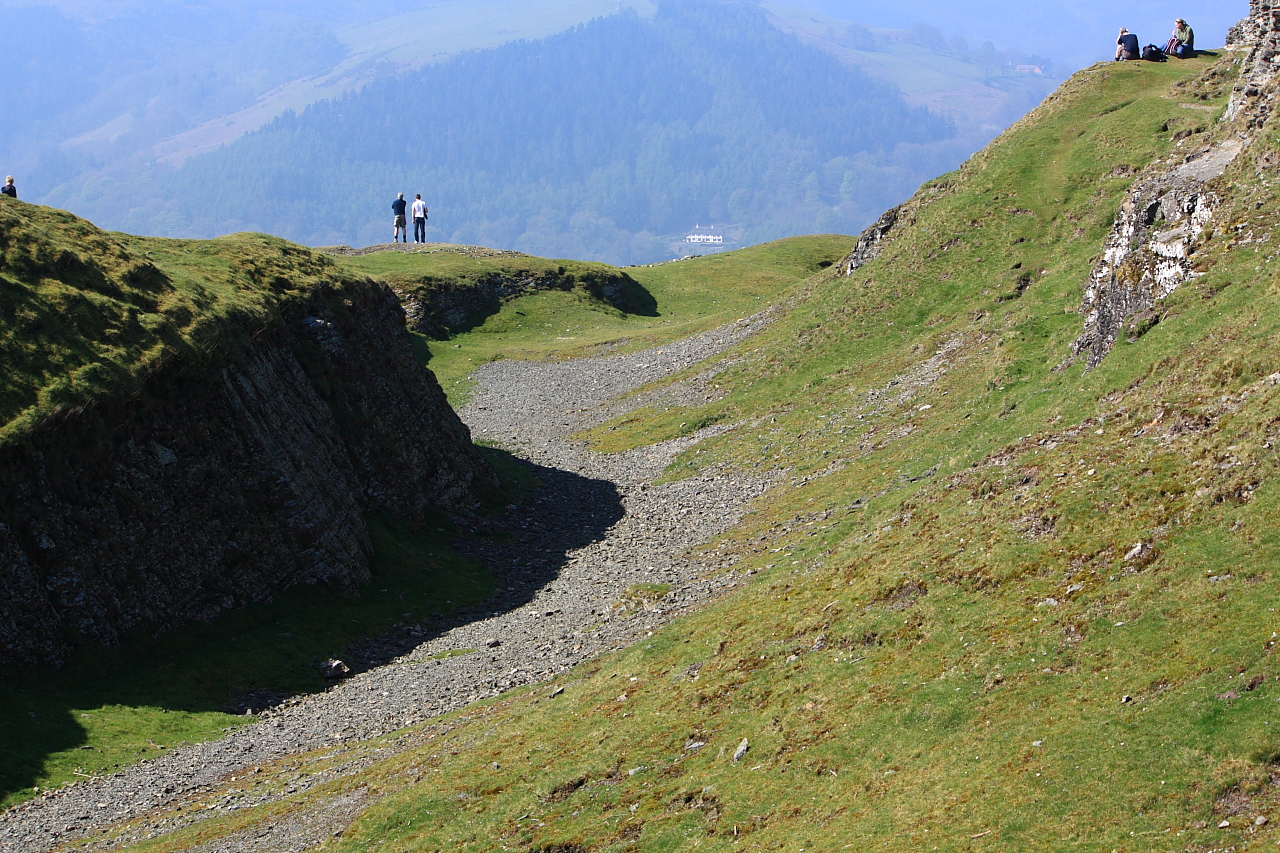
"Dinas Bran" is variously translated as "Crow Castle," "Crow City," "Hill of the Crow," or "Bran's Stronghold." The castle first appears in 12th century historical documents as part of a medieval piece entitled "Fouke le Fitz Waryn,"or "The Romance of Fulk Fitzwarine." While this work claimed that the castle, known as "Chastiel Bran," was in ruin as early as 1073, the remains we see today date to the occupation of the princes of Powys Fadog in the mid 13th century. Possibly, the Chastiel Bran mentioned in the romance was a Norman timber castle, but nothing of substance supports this conjecture. However, the encompassing ditch and earthen embankments, which enclose the southern and eastern portions of the stone fortress, do date to the Iron Age. They remind us that this hilltop had strategic value long before the princes of Powys, or the Normans, ventured into the region. Interestingly, the word, "Dinas," has its origins in the Iron Age as well, and is found in the names of Iron Age hillforts throughout Wales.
Reid (1973) speculated that the hill at Dinas Bran was occupied in the 8th century by a man named Eliseg. The same Eliseg also gave his name to an ancient pillar that stands just north of Valle Crucis Abbey, near Llangollen. The mystery man may have been an ancestor of the princes of Powys who later dominated the area, but there is no real proof to support this assertion.
The historical record also conflicts over whom really built the remains at Dinas Bran. The most reliable sources state that Gruffydd Maelor II, son of Madog ap Gruffydd Maelor I, began the castle in the late 1260's. The elder Madog founded nearby Valle Crucis Abbey, where both men were buried. Some references offer an earlier date for the castle, placing it in the 1230's, when Madog would have been alive and, therefore, its builder. Regardless of whom actually erected the buildings that now survive in ruin, they were part of the last building effort at Dinas Bran. Incredibly, assuming the later date to be most accurate, the Welsh princes only occupied the site for two decades.
During those final two decades, the castle on the hilltop became a prized possession of the princes of Powys Fadog. Dinas Bran's power did not go unnoticed by English forces. In 1277, during Edward I's initial foray into Wales, the Earl of Lincoln, Henry de Lacy, besieged the castle. The Welsh lord of Dinas Bran was forced to submit to the invading army, which promptly set the site afire, completely destroying it.
Even after its devastation, Henry de Lacy marveled at the vigor of the forlorn castle, and recommended that the king make repairs. Lacy noted that the exterior masonry was still intact and that the restored castle could be used by the English, who faced more battles with the Welsh. The Earl of Lincoln exclaimed to his king that there was no greater Welsh castle, nor one in England that could compare with the might of Castell Dinas Bran. Edward I was not impressed, and the castle was never restored.
Shortly after that, however, Castell Dinas Bran and the lands of Bromfield were granted to John de Warenne, Earl of Surrey, a formidable Marcher lord. However, Warenne was more interested fortifying his estates at Holt than in repairing his decaying Welsh stronghold. In 1282, during Edward's second campaign into Wales, Dafydd ap Gruffydd, Llywelyn the Last's rebellious brother, held Dinas Bran. But, Edward's armies captured Dafydd soon after Llywelyn's death at Cilmeri, and took him to a painful execution in England.
As late as the 15th century, Castell Dinas Bran still had value. Then the property of Thomas Fitzalan, Earl of Arundel, the castle was targeted by the legendary folkhero, Owain Glyndwr, who unsuccessfully attempted to capture the site in 1402. During the reign of King Henry VIII, John Leland, the king's well-traveled chronicler, described Dinas Bran as a total ruin. He claimed that the only living being willing to inhabit the castle ruins was the eagle who returned each year to breed.
In more recent centuries, Castell Dinas Bran was recognized for its dramatic placement high above the Welsh valleys. Painters, like Turner and Wilson, captured the essence of the place on canvas. Wordsworth also visited Dinas Bran, lamenting the castle's fate as follows:
"Relics of kings, wreck of forgotten wars, To the winds abandoned and the prying stars."
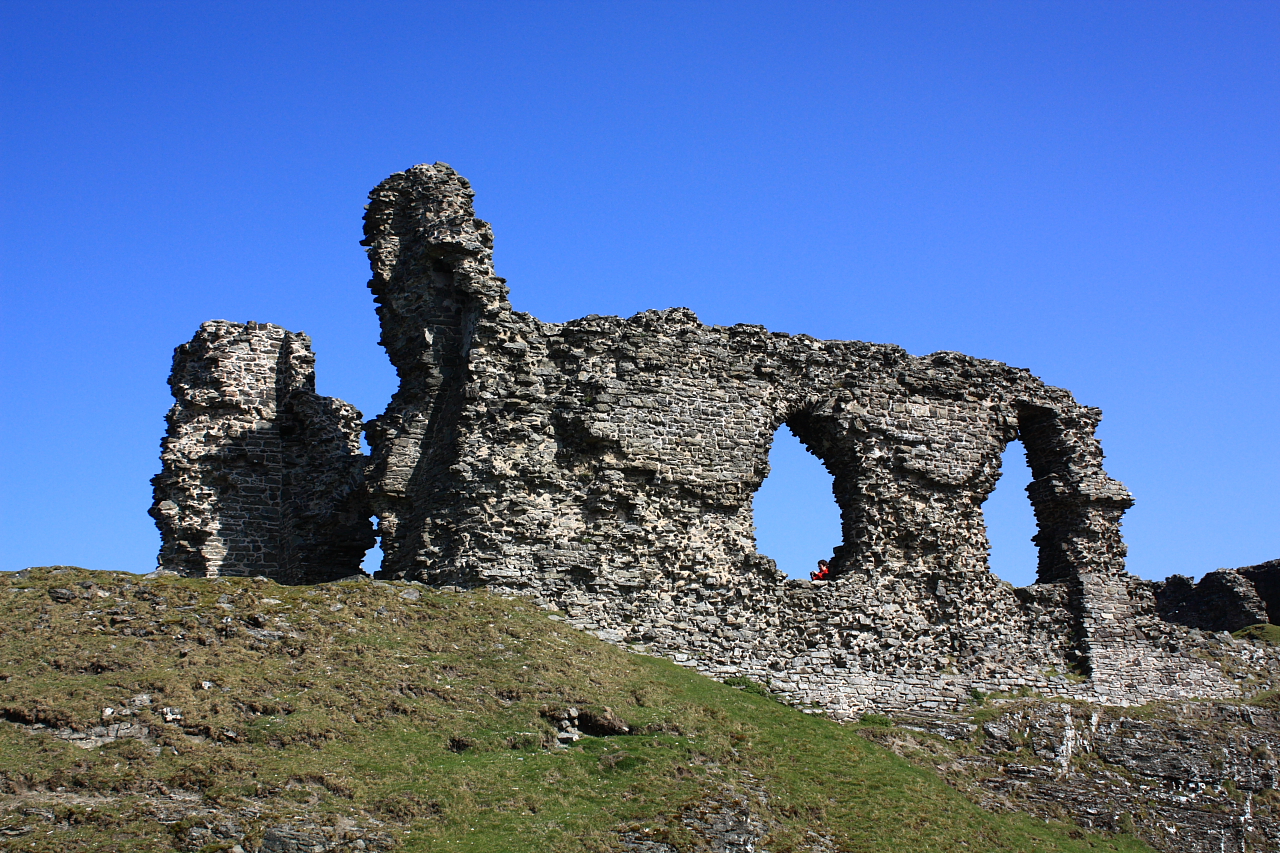
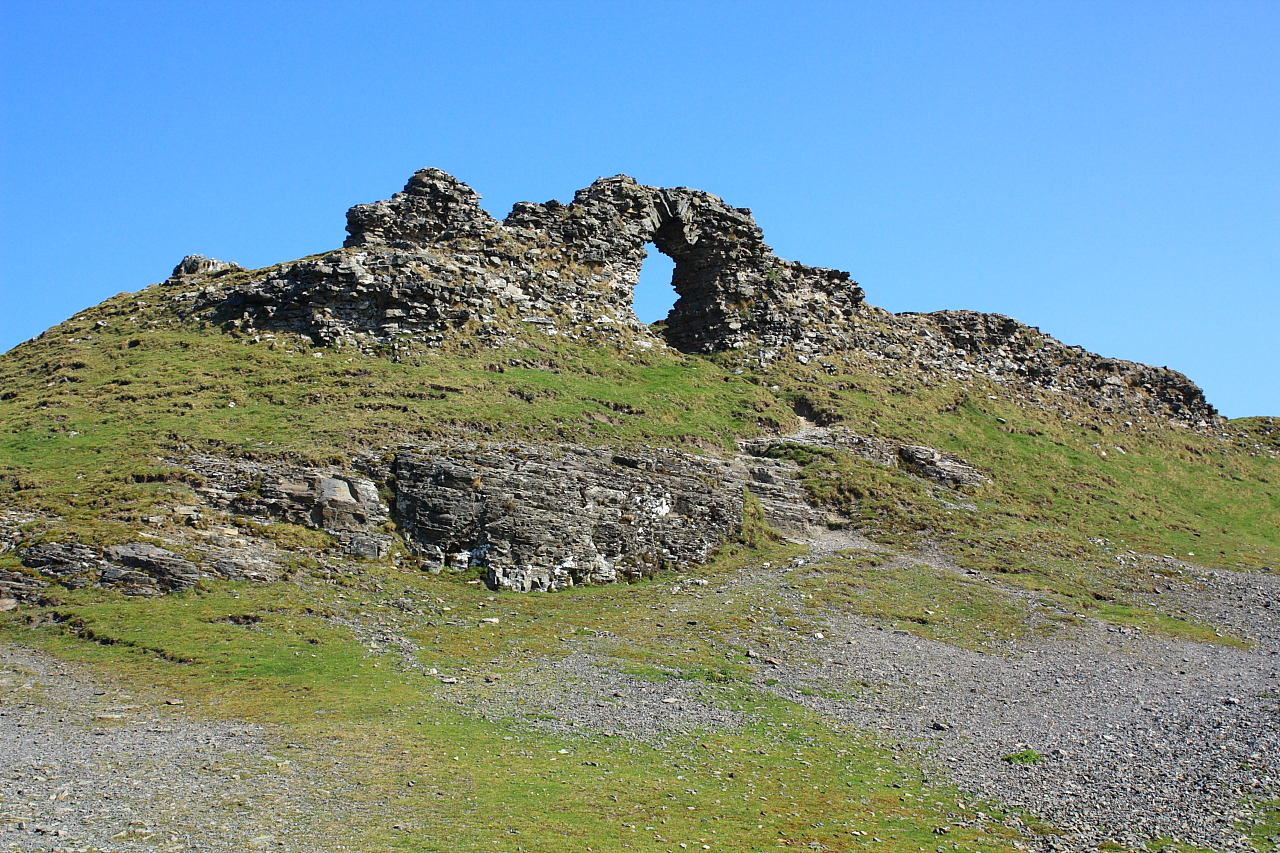
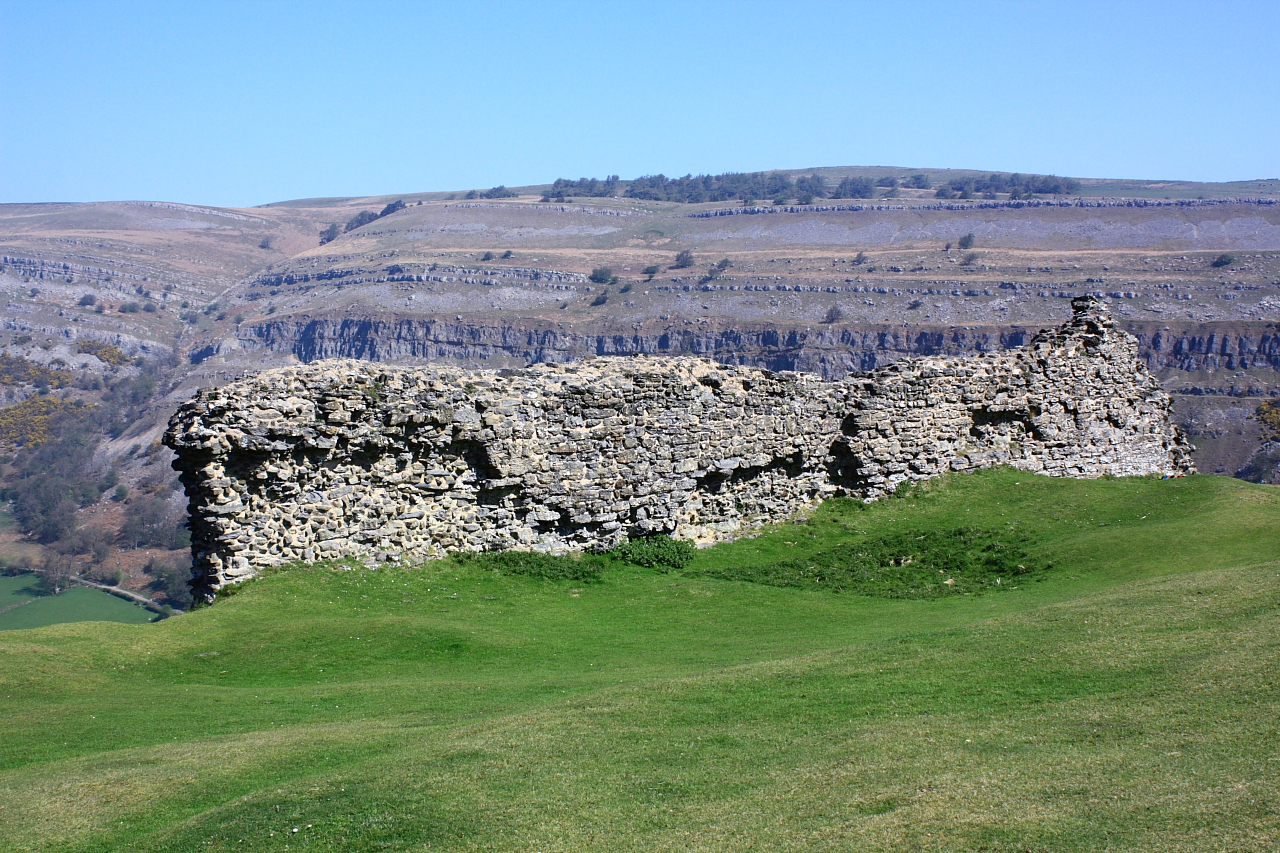
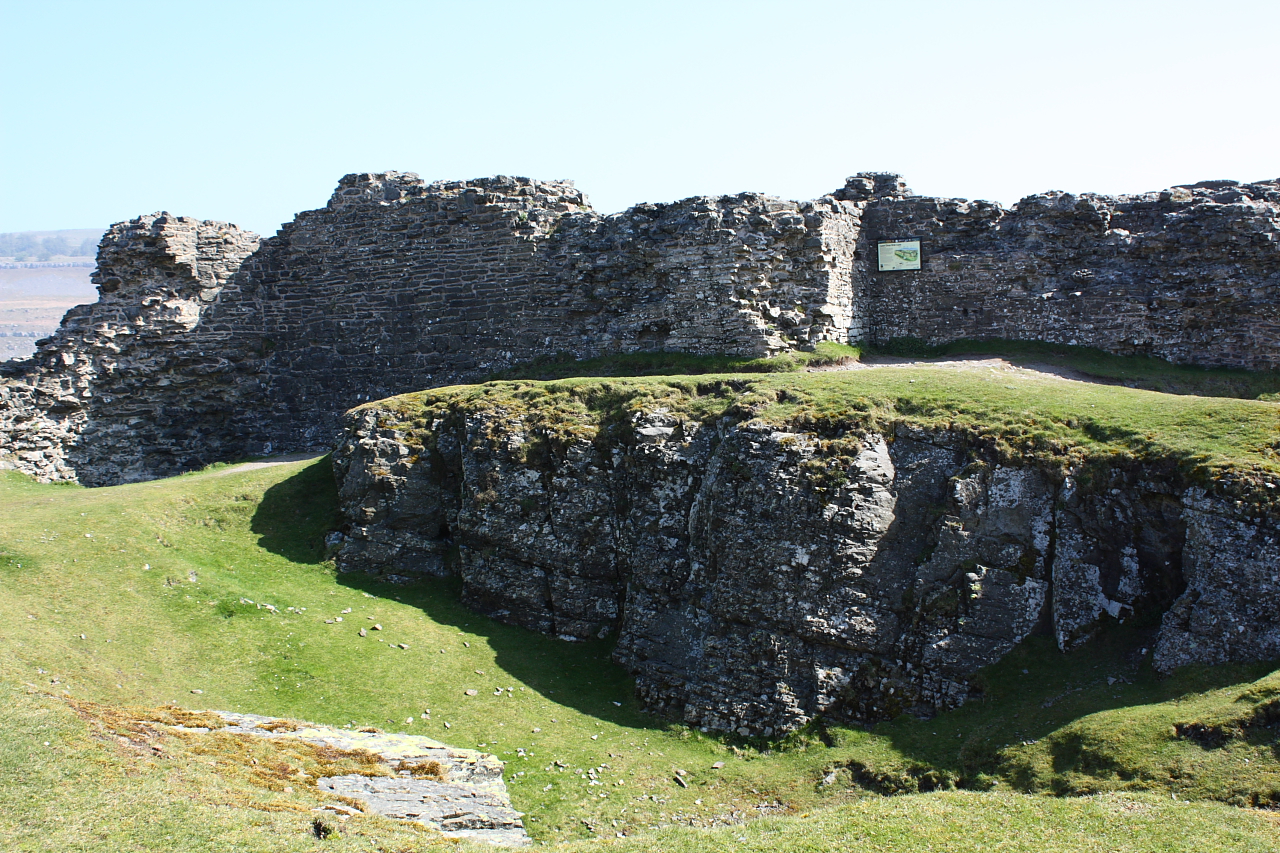
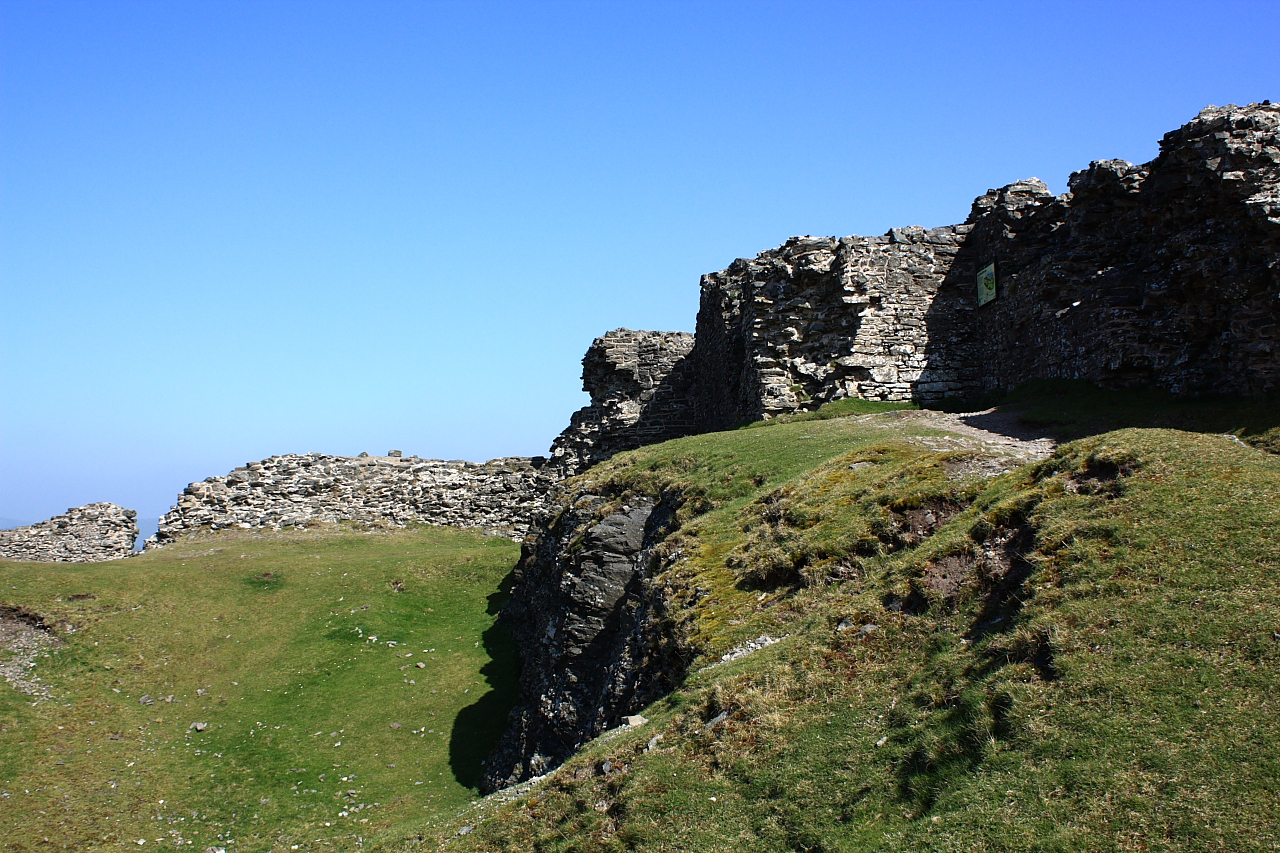
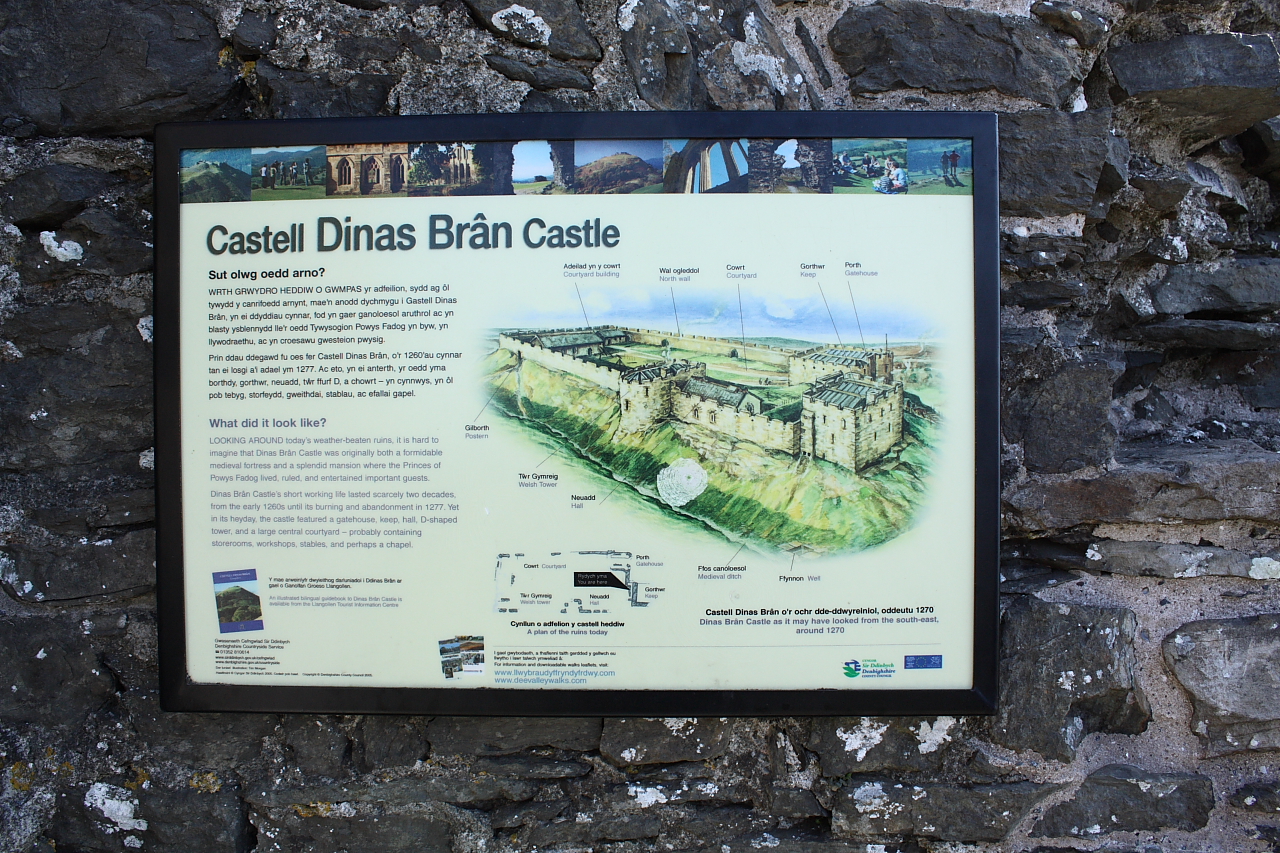
From afar, we can readily spot the tumbledown ruins of Castell Dinas Bran. In many ways, it was a typical Welsh-built castle. Surprisingly simple in design, its stone curtain wall traced the outline of the hilltop upon which it stood. Essentially rectangular, the wall enclosed an area about 300 feet long and 130 feet wide. At the eastern end, a plain square keep connected to the curtain wall. Like many other keeps, access was at the first level above the ground floor, using a movable wooden ladder.
Immediately to the right (north) of the keep stood the great twin-towered gatehouse, a primitive structure when compared to its Edwardian counterparts under construction at the same time. This native Welsh gatehouse was rib-vaulted and had a narrow passage into the inner bailey. Little remains except the foundations.
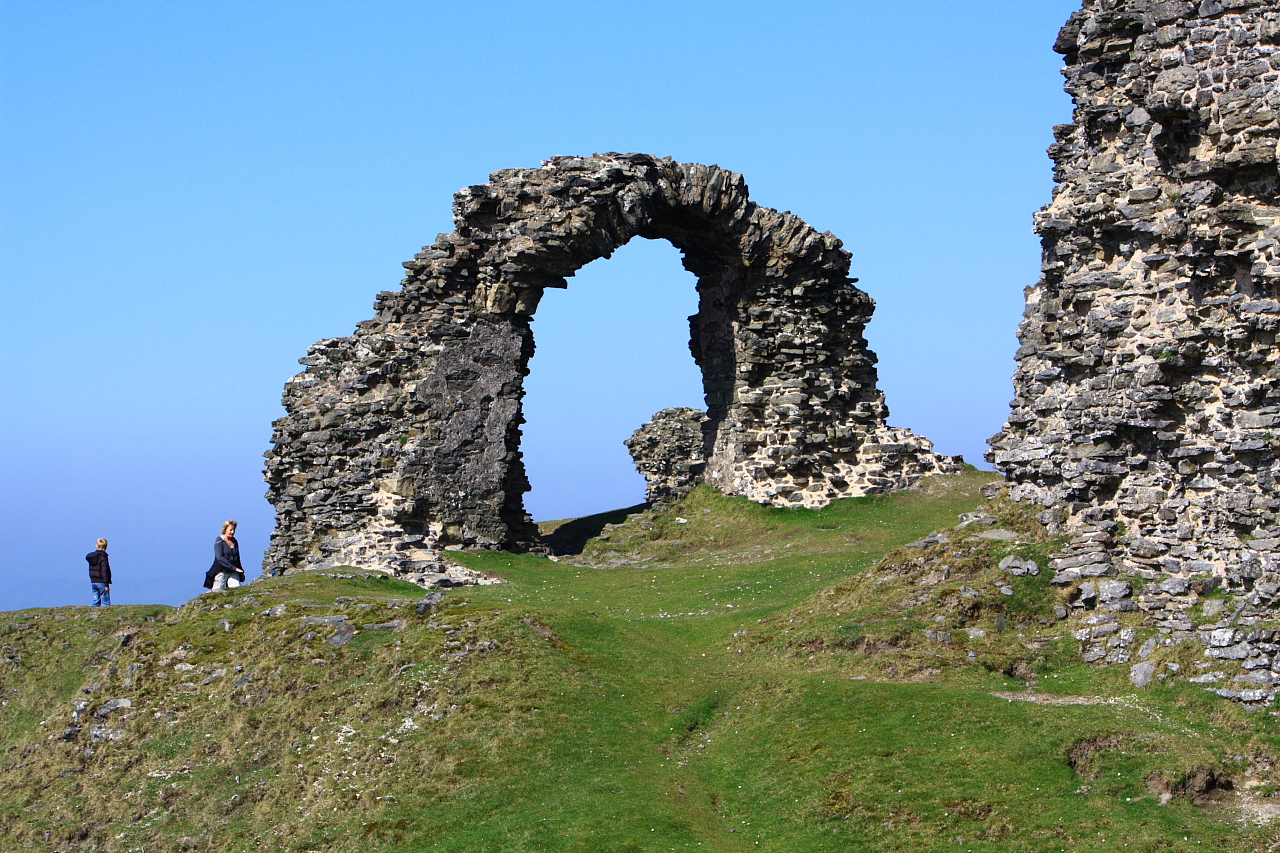
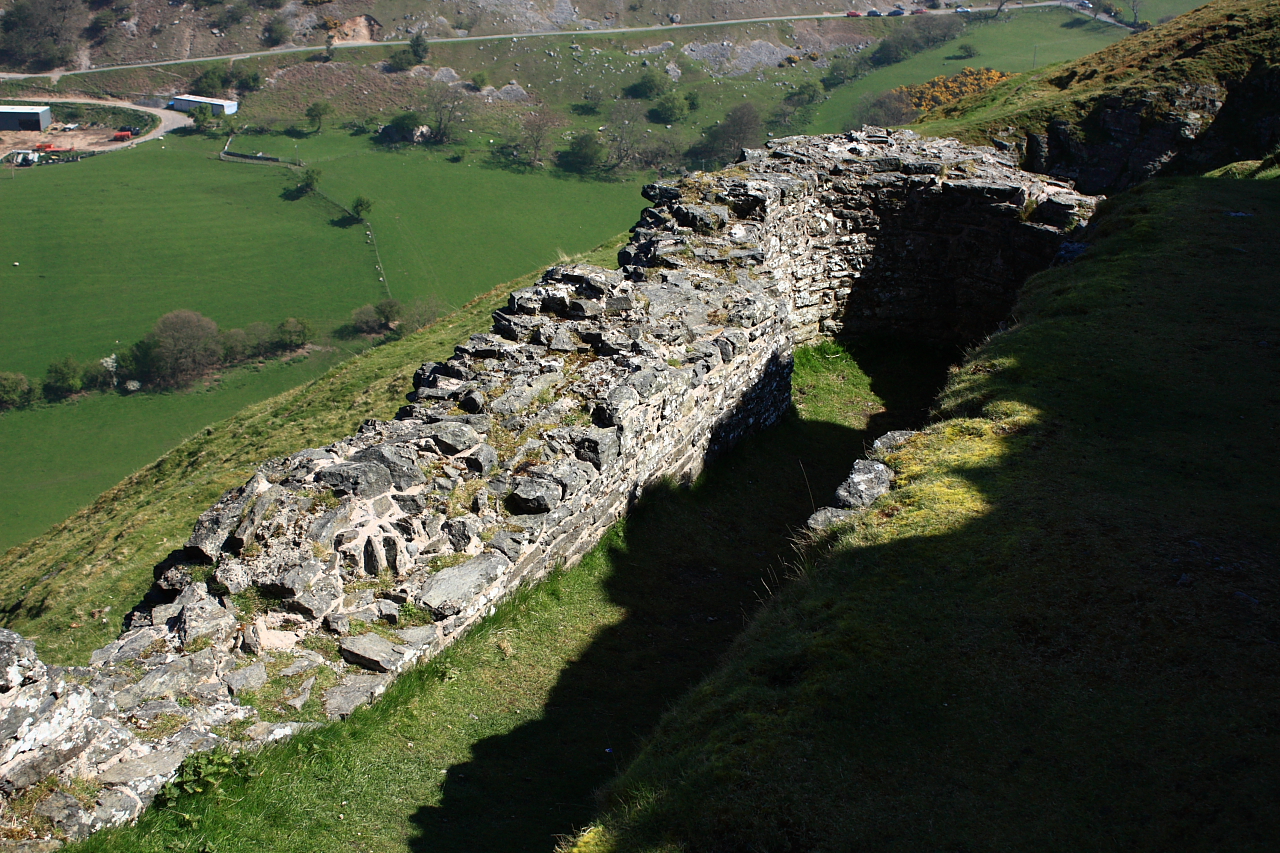
Midway along the southern wall, a characteristically-Welsh apsidal tower protrudes outward from the castle walls. The intriguing D-shaped tower still offers panoramic views of the less-sloping western approach to the castle, the sector which would have been most vulnerable to attack. Adjacent to this tower are the scanty remains of the hall block, once the castle's focal point, where the lord would have entertained his guests. The castle's priest may have offered religious services on an upper level.
TALES OF DINAS BRAN
Legends associate Castell Dinas Bran with the king of Britain mentioned in the "Mabinogion," whose story dates to Arthurian times and whose name (Bran) translates to "raven." The king was killed after invading Ireland, and his head was buried in what may have been London's Tower Hill. Stories then added that, as long as Bran's head remained buried, Britain would be safeguarded. Perhaps, the idea that the head is linked with the Tower of London derives from the ongoing presence of real ravens, creatures also said to have the magical power to protect the kingdom from disaster. Tales also state, however, that King Arthur retrieved the head, choosing to protect Britain himself rather than resorting to the power of a buried body part. Claims have also been made that the Holy Grail or a golden harp are hidden in the hillock at Dinas Bran and that fairies dwell there.
According to "The Romance of Fulk Fitzwarine," the Normans pushed their way into the eastern borderlands of Wales and stopped just beneath the ruins of Dinas Bran. An arrogant knight, Pain Peveril, noticed the crumbling walls and learned that the site was once the home of King Bran. Since Bran's demise, no one had enough courage to stay overnight inside the remains, for fear of evil spirits. To prove their mettle, Pain and some of his cohorts climbed up to the ruins, determined to endure the night. During that night, a storm arose and forced the men to seek shelter.
Suddenly, an evil, mace-wielding giant appeared. This giant was the notorious Gogmagog, a man possessed by an evil spirit who had terrorized the countryside for years. Pain defended his men with his shield, protected with a cross, a shield so sturdy that it withstood the penetration of the giant's mace. His brazen defiance startled the giant and Pain swiftly stabbed him with his sword. As Gogmagog died, the evil spirit recounted KingBran's bravery against the giant's attacks. Bran had even built the palace atop the hillock to thwart the giant and enraged the evil spirit inside Gogmagog. Then, the giant forced Bran and his followers to flee. The dying spirit also claimed that a great treasure, including a golden ox, was buried beneath the hill. The next day, King William learned of Pain's adventure, disposed of Gogmagog's body, and kept the mace as a spoil of battle.
(This tale was paraphrased from Oman's account in the book, "Castles," written originally in the 1920's. It is a classic text on British castles.)
Today, Castell Dinas Bran overlooks the Welsh valleys, as it has done for centuries. It is now in the care of the local authority, and is open freely any reasonable time. One can only wonder if the golden ox is still embedded somewhere inside the hill!
An avid traveler, Lise Hull is a freelance historian and writer, with a Masters Degree in Historic Preservation. She previously obtained a BA in anthropology, minoring in archaeology, and spent almost three years studying archaeology at Indiana University prior to switching into the preservation program. Lise has lived in Pembrokeshire and Ceredigion Wales for several years, traveled over 50,000 miles throughout Britain, and has studied castles and medieval Britain for sixteen years. She often returns to Great Britain for research, and has just completed her master's dissertation in Heritage Studies in the Department of History and Welsh History at the University of Wales, Aberystwyth.
Jeff Thomas 1995
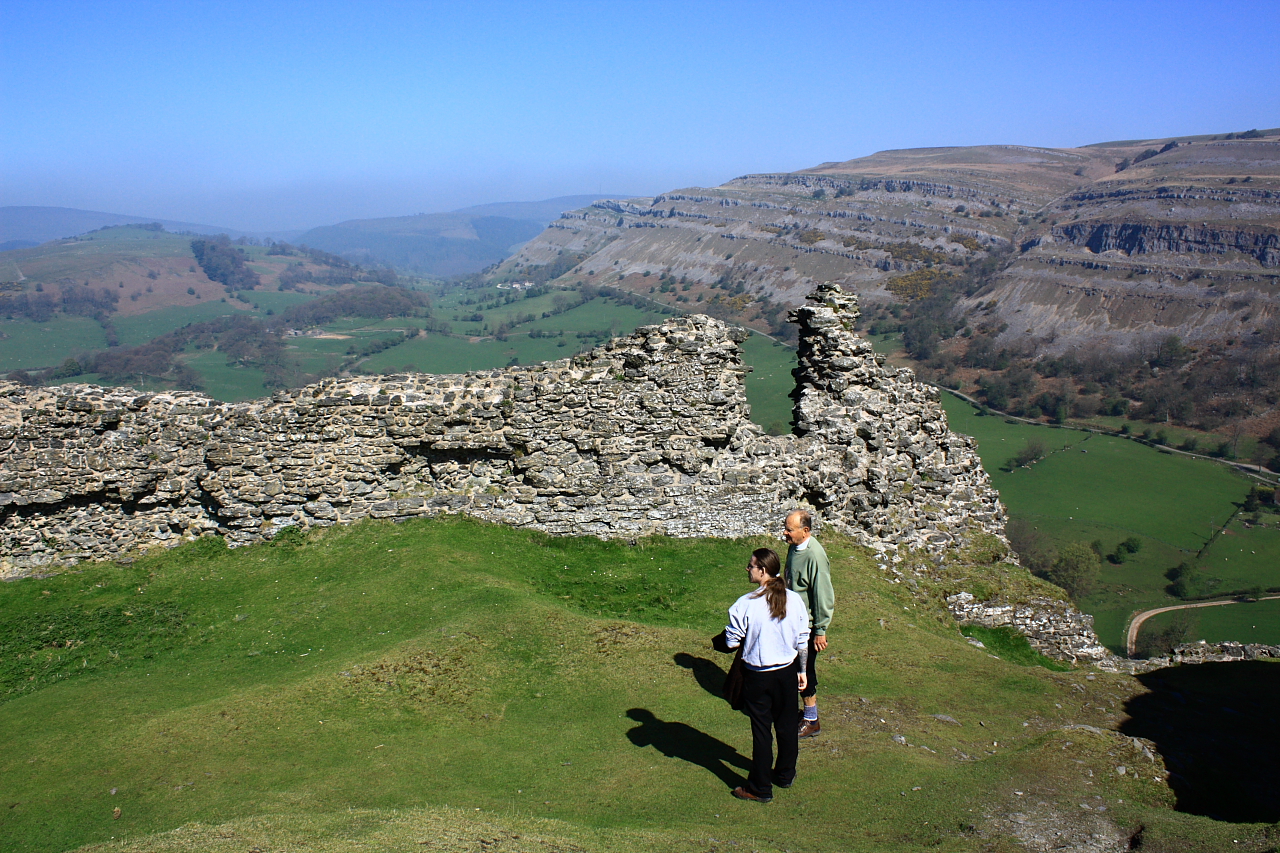
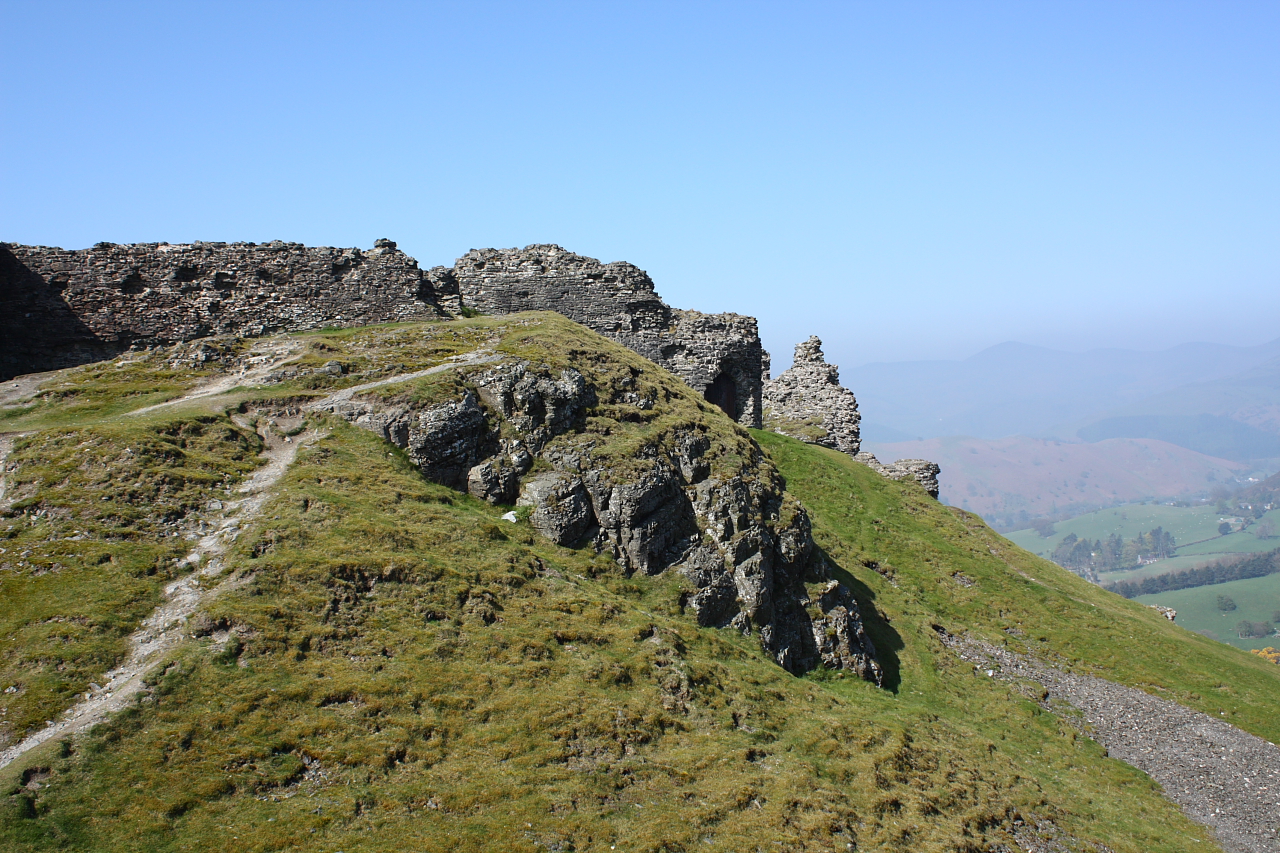
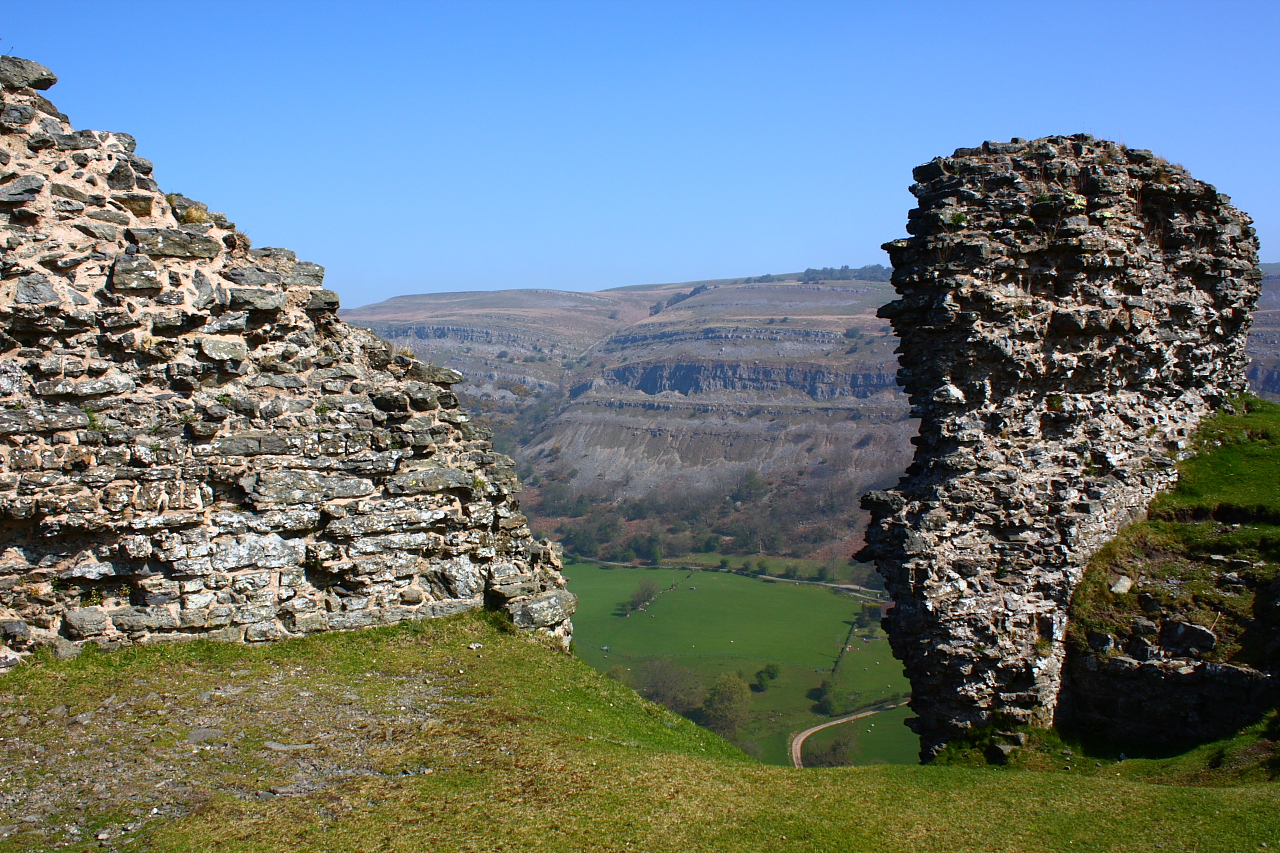
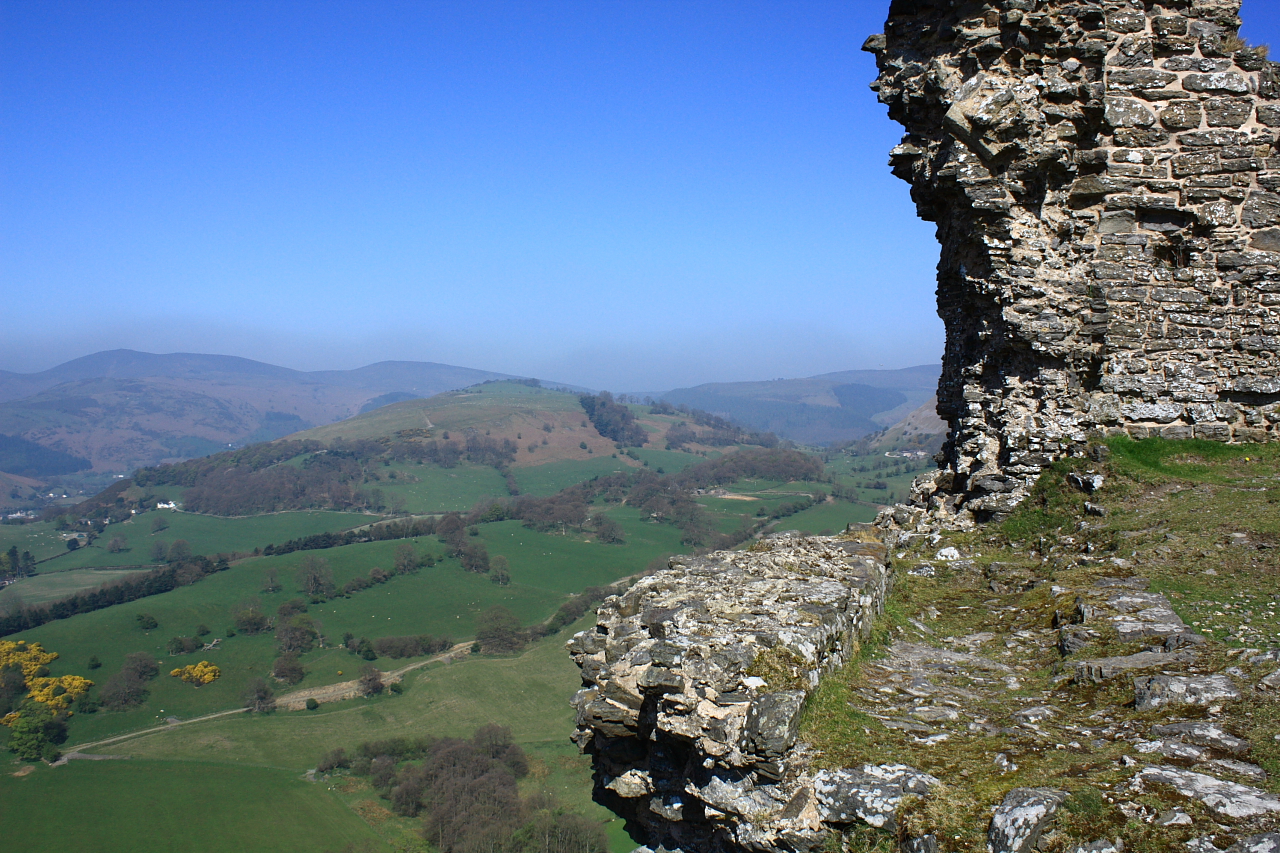
So why take the time to visit Castell Dinas Bran? The remains are indeed slight, and it's difficult to picture how the castle may have looked in its prime without the help of an artist's reconstruction. Still, the site is among the most compelling I've visited in Wales. The historic importance of the castle (mentioned above) combine with the breathtaking grandeur of its siting to create yet another unique Welsh castle experience. You may in fact find yourself spending more time gaping at magnificent views across the beautiful Dee Valley below than examining the remains of the castle. It's very important to remember that there's more to a "castle experience" than simply examining the ruins, although the ruins at Dinas Bran are certainly worth exploring. But, like Castell y Bere and Carreg Cennen, Dinas Bran's dramatic surroundings and an appreciation for its strategic siting make exploring this Welsh castle a more rewarding experience than others more familiar to tourism and literature. In Wales, it almost always pays to make sure your travels lead you "off the beaten-track" a bit, and a visit to stunning Castell Dinas Bran demonstrates why such trips are so important.
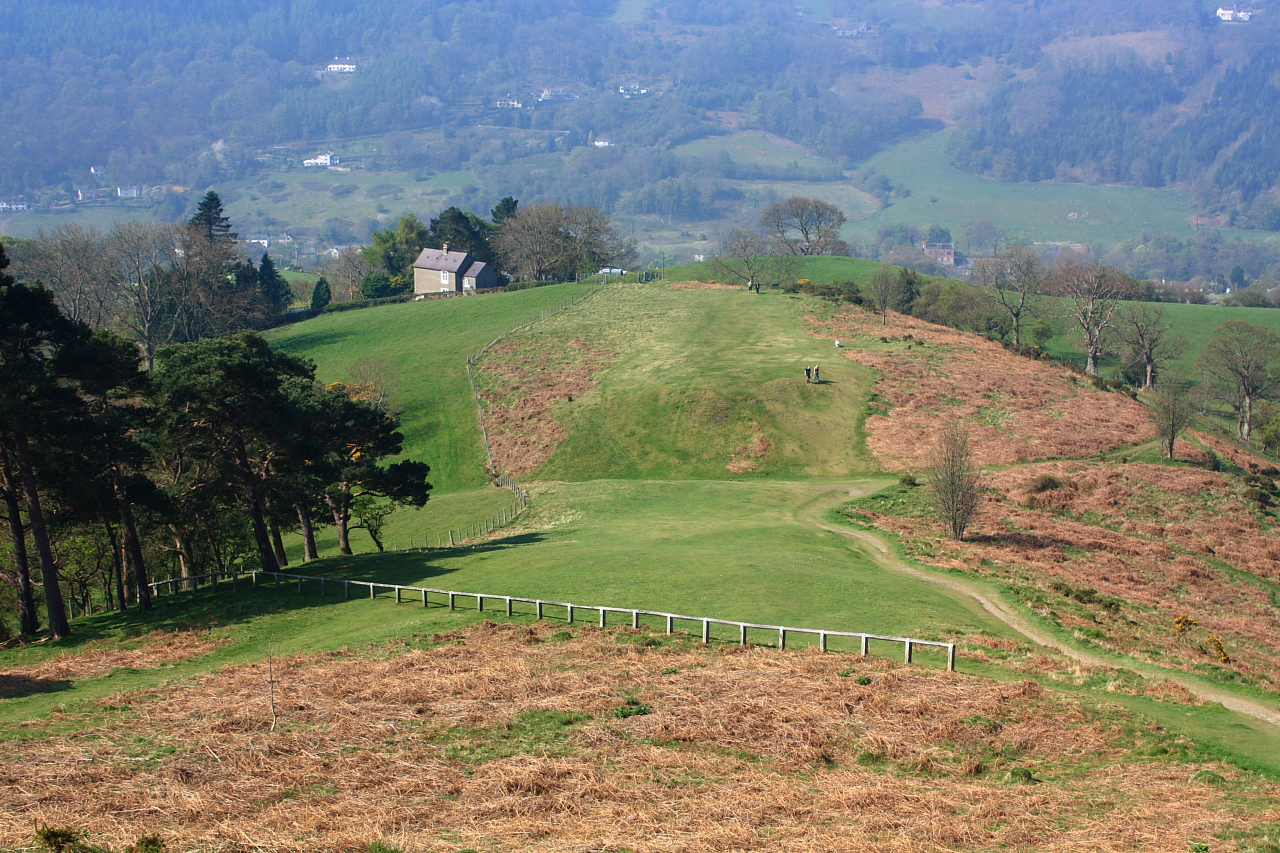
Our trip to the castle in 1995 turned out to be the wildest Welsh castle experience I've had to date. Dinas Bran sits atop a hill about 1,000 ft above the floor of the Dee Valley in Llangollen. There's a well-marked path to the castle, however, the climb to the top is not an easy one. The castle sits majestically on its steep hill. The view of the castle from the valley below is matched only by the magnificent views of the green valley from its summit, and you'll curse yourself if you forget to take your camera!
Although it was mostly sunny the day we visited, once we reached the castle we were immediately reminded of why people often claim that the weather in Wales is best described as "changeable." In the course of the next hour we experienced what seemed like all four seasons at once. We went from totally calm winds to gusts of about 40 mph; beautiful blue, sunny sky to overcast, then light rain; then a hail storm, and back to beautiful calm, blue sky. Then the cycle repeated itself! The sheep, on the other hand, didn't seem to mind, and continued their grazing as they have for hundreds of years. No matter. It could have snowed 10 ft without diminishing the impact of the beautiful valley seen from our high vantage point. Certainly there are some interesting remains to be explored at Dinas Bran, but it's the beauty of the surrounding countryside from the summit of the castle that's the most compelling. If you're ever in the area or even staying in Llangollen, make sure you take the time to visit this remarkable castle, yet another fine example of why native Welsh castles are the favorites of some.
|

 Map link for Castell Dinas Bran

 Learn more about medieval Powys